 STOKE
← Back to the app
STOKE
← Back to the app
How STOKE works
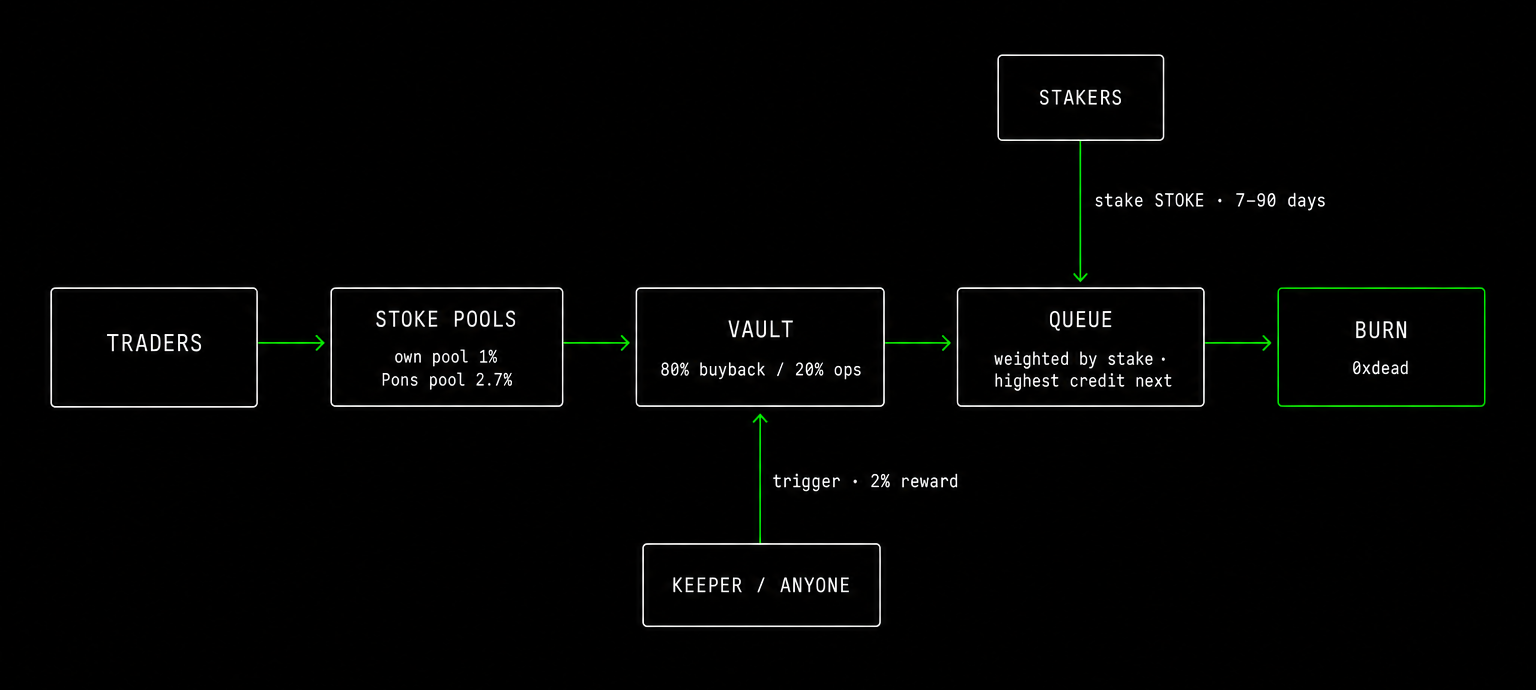
STOKE is a buyback-and-burn engine on Robinhood Chain. Trading fees fill a vault; the vault buys tokens that people have staked STOKE behind, and burns everything it buys. This page names the moving parts and the rules. Anything deeper, read the contracts on chain.
01Fee hook
The STOKE/USDG pool run by this protocol is a Uniswap v4 pool with a custom hook. The hook takes 1% of every swap, always in USDG, and credits it to the vault as a claim inside the PoolManager. The pool's own LP fee is zero, and the LP position is held by the vault with no path to withdraw it.
The Pons pool that STOKE launched on is separate. Its trades pay 3% (1% Pons hook fee + 2% creator tax); the creator share of that, 2.7% of each trade, is routed to the vault. Nothing reaches the vault from the Pons pool until STOKE graduates from its launch curve.
02Vault
The vault is the treasury, the stake ledger, and the buyback executor in one contract. It has an owner who can tune bounded parameters, pause new staking, and clear strikes. There is no function that withdraws funds.
| Inflow split | 80% to the buyback budget, 20% to operations. Direct USDG transfers skip the split and are 100% buyback. |
| Threshold | A buyback fires once the budget reaches 30 USDG; each buyback spends at most 50 USDG. |
| Trigger | Anyone can call execute() once the threshold is met and earns 2% of the spend. A keeper does it as a backup. |
| Buy | Bought on the token's own pool at market price, with a 3% impact limit; USDG-quoted tokens in one hop, ETH-quoted tokens via USDG → ETH → token. |
| Burn | Everything bought is sent to 0x…dead in the same transaction. If a buy or burn fails, the token gets a strike; three strikes pause it. |
| History | Every buyback is recorded on chain: caller, timestamp, token, USDG spent, tokens burned. |
03Queue
Staking STOKE behind a token gives that token weight: weight = amount × lock days, lock 7 to 90 days, fixed when you stake. Each buyback credits every token in proportion to its share of total weight. The token holding the largest accrued credit is bought next, and its credit is reduced by what was spent. That is the whole ordering rule; there is no randomness and no admin pick.
- Up to 64 tokens in the queue. Registering a new one needs a minimum stake; adding to an existing one has no minimum.
- Unstake any time after your lock ends. The vault charges no fee on stakes; you pay gas.
- Accrued credit is capped so a long-starved token cannot dump one oversized order into a thin pool.
04Who can be registered
Eligibility is checked by the contract, not by a person. Two entrances:
- Pons: the token has graduated from its launch curve, is quoted in ETH or USDG, and its creator tax is 3% or less. Pons graduated pools have their liquidity locked forever.
- Uniswap Liquidity Launchpad (pools.trade, Bankr): the pool has no hook, is quoted in ETH or USDG, and a permanently locked position holds at least half of its liquidity.
Tokens that were not launched through either are not eligible in this phase.
05Keeper and dashboard
A small off-chain service reads the chain every 30 seconds for the dashboard, checks address eligibility, and fires execute() when a ready state has persisted for two minutes with no one else taking the reward. It holds only gas money. If it stops, the dashboard falls back to reading the chain directly, and buybacks continue whenever anyone calls execute().
06Addresses
| Chain | Robinhood Chain (id 4663) |
| Vault | 0x022c317A9eEdAd2b4dDbD0a44863D0788E95D781 |
| Fee hook | 0xea0bf63D67D7614d0eB80A85356856443467a0cc |
| STOKE token | 0x3C31D6a3FA1c578F9A7e6f2Ef45C10f7255eD3Fb |
| USDG | 0x5fc5360D0400a0Fd4f2af552ADD042D716F1d168 |